
Three days at the Michigan Union featuring the 2026 REx Symposium and the student-led Conference Across MRSEC-PREM Schools (CAMPS).

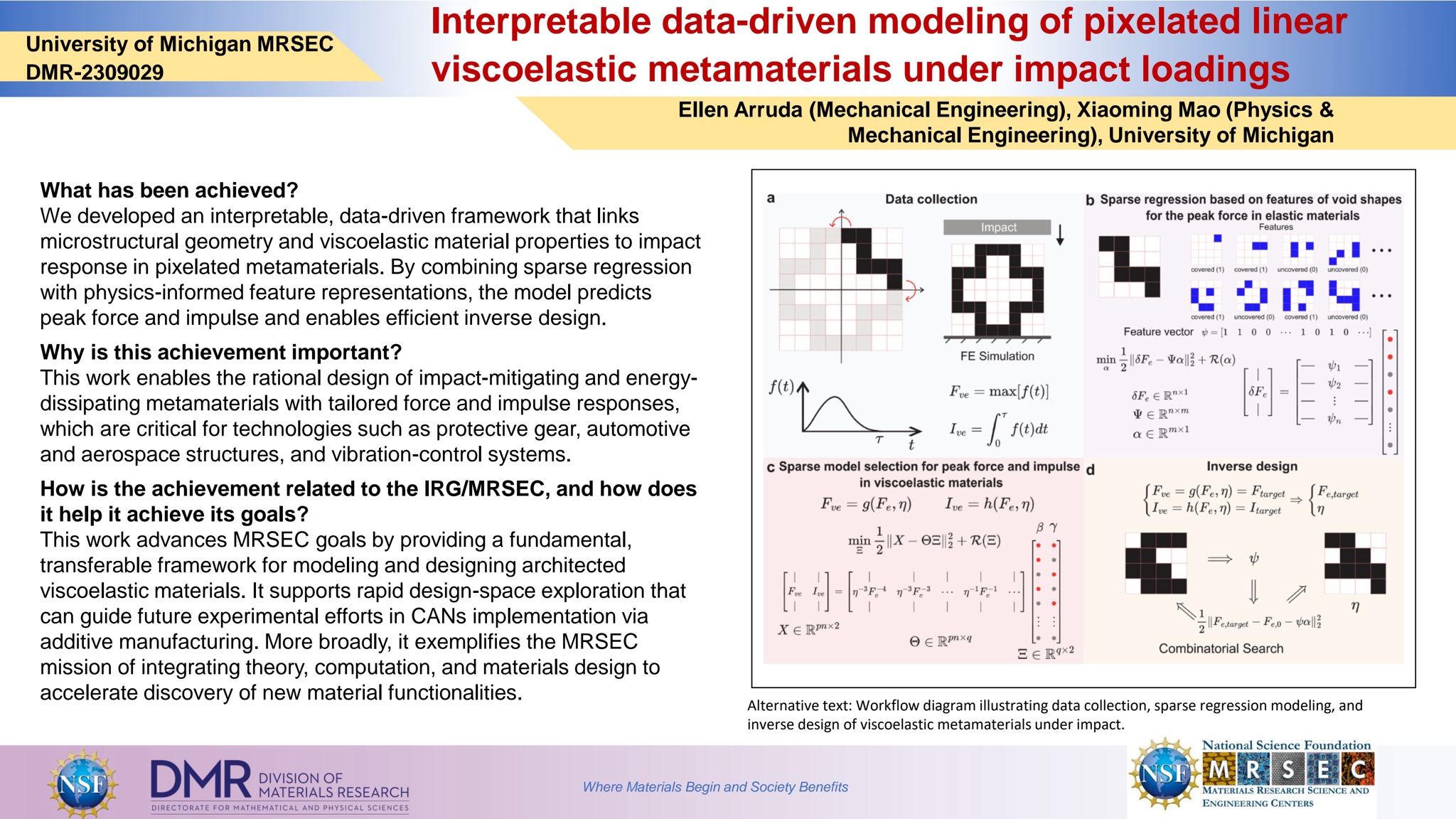
An interpretable, data-driven framework links microstructure and viscoelastic properties to impact response, enabling inverse design of impact-mitigating metamaterials. Comput. Methods Appl. Mech. Eng. 457, 118936 (2026)
Two days of industry-academia presentations, an industry panel, and poster sessions spanning high school to PhD students at Rackham Graduate School.

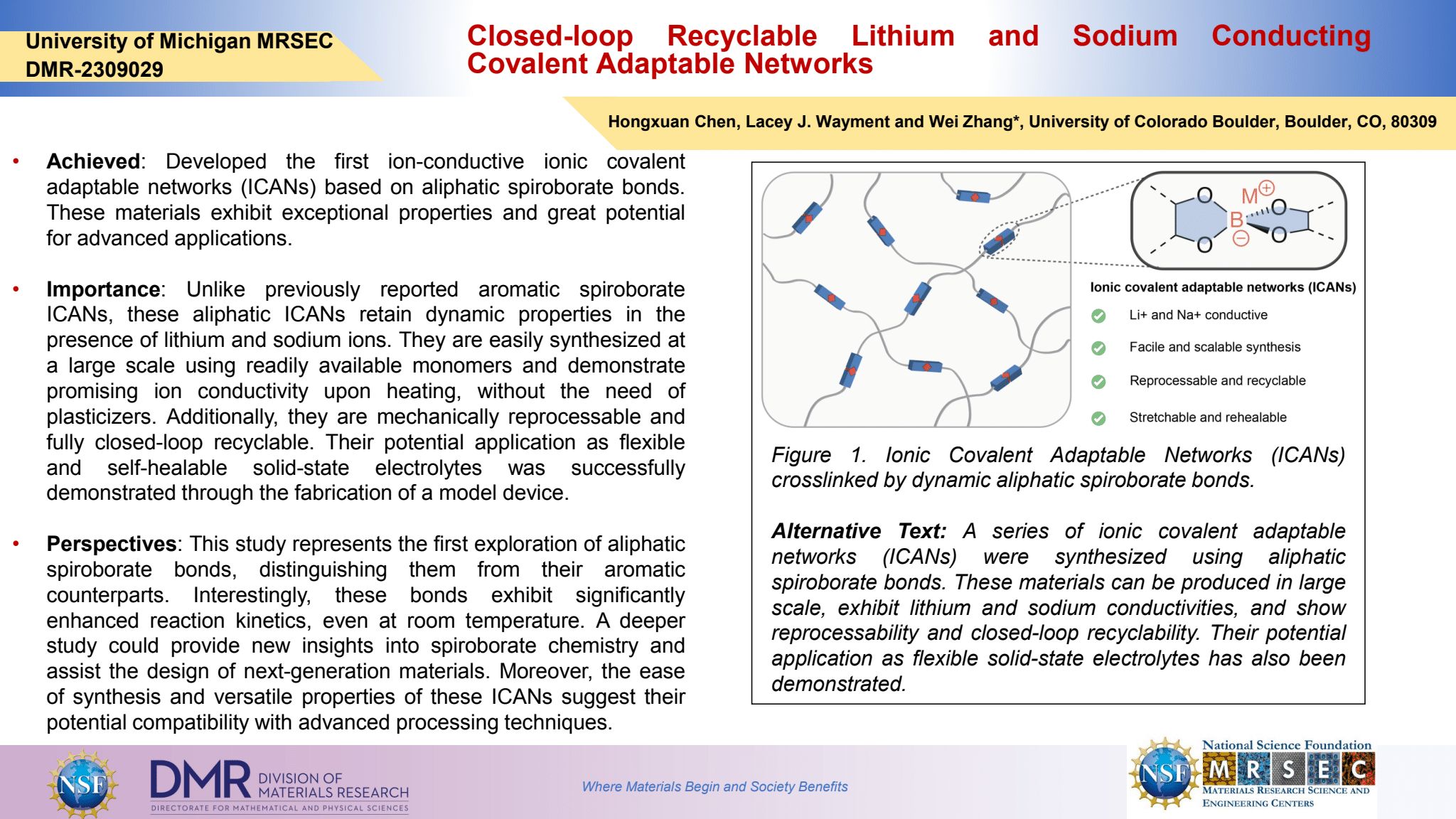
Ionic covalent adaptable networks built on aliphatic spiroborate bonds conduct lithium and sodium ions and can be rapidly reprocessed and closed-loop recycled. Angew. Chem. Int. Ed. 64, e202425497 (2025)
A polydopamine-assisted electroless deposition method produces uniform magnetic coatings for 3D-printed microrobots. Adv. Intell. Syst. 7, 2400702 (2025)

Photoemission spectroscopy and ab initio GW calculations reveal an exceptionally large exciton binding energy in the bulk van der Waals antiferromagnet CrSBr, driven by quasi-1D electronic localization. Nat. Commun. 16, 1134 (2025)

A universal spectral moment theorem for non-Hermitian systems lays the theoretical foundation for viscoelastic metamaterials with unusual dynamical properties. Phys. Rev. Lett. 133, 216401 (2024)

Molecular dynamics simulations reveal how dynamic disulfide bond reorientation drives three-stage creep in vitrimers. Polymer 313, 127667 (2024)

CSU engineering undergraduates toured CMI labs and facilities, launching a formal partnership for CSU students to join the CMI summer research program.

Liquid crystal polymer networks combined with structural protein films enable electronics-free, self-propelled swimming soft robots. Adv. Funct. Mater. 34, 2413129 (2024)

 hi