
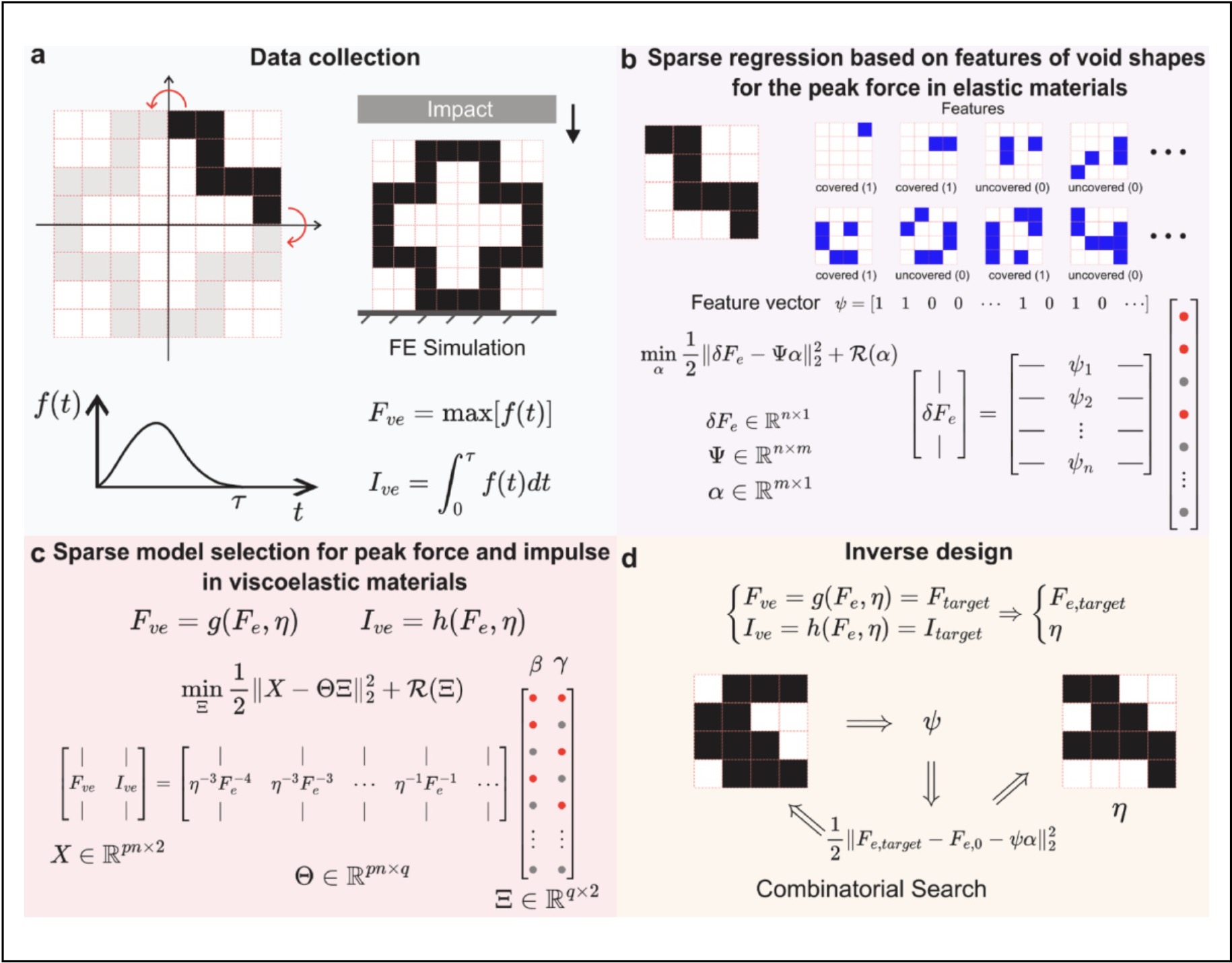
Workflow diagram illustrating data collection, sparse regression modeling, and inverse design of viscoelastic metamaterials under impact.
We developed an interpretable, data-driven modeling framework for predicting and designing the impact response of pixelated linear viscoelastic metamaterials. The approach hierarchically decomposes the problem by first establishing a sparse, physically interpretable model that links microstructural geometry to the peak force in elastic metamaterials. Building on this elastic backbone, we model viscoelastic peak force and impulse as nonlinear functional transformations governed by the viscoelastic coefficient. The resulting models are compact, accurate, and computationally efficient, and they enable direct inverse design of microstructures and material parameters for target impact performance.
This work enables new technologies based on architected viscoelastic materials with programmable impact and energy-dissipation properties. The ability to directly design microstructures that achieve target peak force and impulse responses is crucial for applications such as protective equipment, crash-resistant automotive and aerospace components, vibration isolation, and wave-attenuating structures. Unlike traditional viscoelastic materials, whose performance is largely fixed by bulk material properties, the metamaterials enabled by this framework can be custom-designed for specific loading scenarios. By providing a fast, interpretable inverse-design capability, our framework significantly lowers the barrier to deploying these materials in real engineering systems. It allows designers to move beyond empirical tuning and instead create lightweight, high-efficiency, and application-specific impact-mitigation solutions, opening pathways toward next-generation structural protection and adaptive mechanical systems.
This work advances MRSEC goals by providing a fundamental, transferable framework for modeling and designing architected viscoelastic materials. It strengthens the theoretical foundation needed to connect microstructure to function and supports rapid design-space exploration that can guide future experimental efforts in CANs implementation via additive manufacturing. More broadly, it exemplifies the MRSEC mission of integrating theory, computation, and materials design to accelerate discovery of new material functionalities. This is a collaboration between the Arruda (Mechanical Engineering) and Mao (Physics & Mechanical Engineering) groups.
Published: S. Li, X. Zhai, X. Mao, E. M. Arruda, “Interpretable data-driven modeling of pixelated linear viscoelastic metamaterials under impact loadings,” Computer Methods in Applied Mechanics and Engineering 457, 118936 (2026). https://doi.org/10.1016/j.cma.2026.118936
 hi