
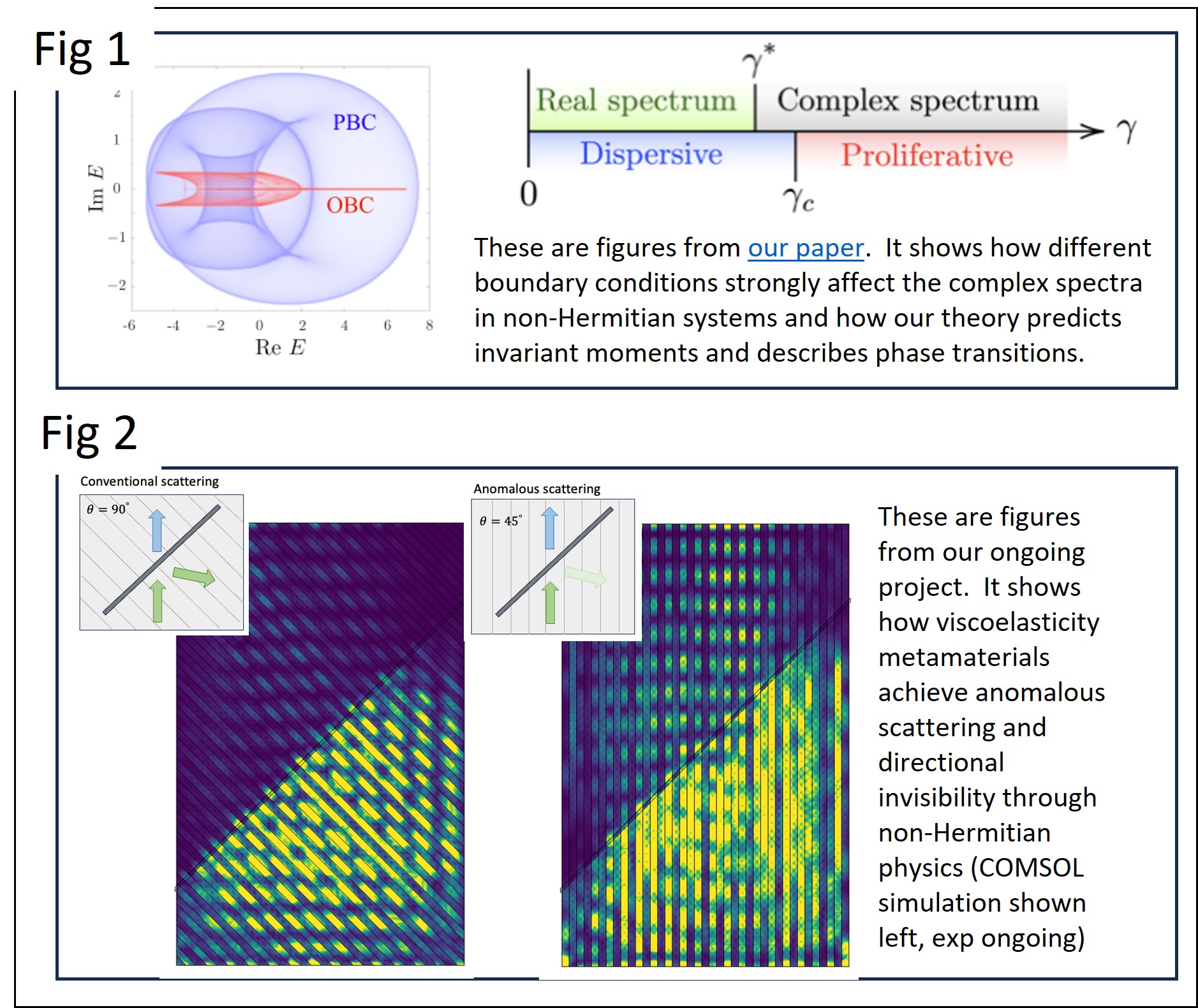
Fig. 1: Boundary conditions strongly affect the complex spectra of non-Hermitian systems; the theory predicts invariant moments and describes phase transitions. Fig. 2: Viscoelastic metamaterials achieve anomalous scattering and directional invisibility through non-Hermitian physics (COMSOL simulations).
In the past year, our work has been focusing on developing mechanical metamaterials where viscoelasticity is used to achieve unusual dynamical properties. We have published one paper on a fundamental theory for non-Hermitian systems which directly applies to viscoelastic metamaterials and reveals novel phase transitions (Fig 1). We are currently experimentally studying viscoelastic metamaterials for wave manipulation (Fig 2). (ii) We initiated a new project with the Kieffer group where we recover the dielectric function of CANs by fitting it with Maxwell-Wagner-Sillars interfacial polarization model capturing electrode polarization and segmental relaxation.
Achievement (i) opens novel applications of CANs to the broad field of metamaterials and functional materials. The special tunability of CANs provide a highly valuable control for these applications. Achievement (ii) is expected to reveal relations between macroscale characteristics and internal mechanisms, an input for building fundamental theories.
Achievement (i) is an important part for the implementation of CANs for novel materials. Achievement (ii) supports the fundamental theory building of CANs. Both are important aspects of IRG 2 research.
Published: N. Cheng, C. Shu, K. Zhang, X. Mao, K. Sun, “Universal Spectral Moment Theorem and Its Applications in Non-Hermitian Systems,” Physical Review Letters 133, 216401 (2024). https://doi.org/10.1103/PhysRevLett.133.216401
 hi